



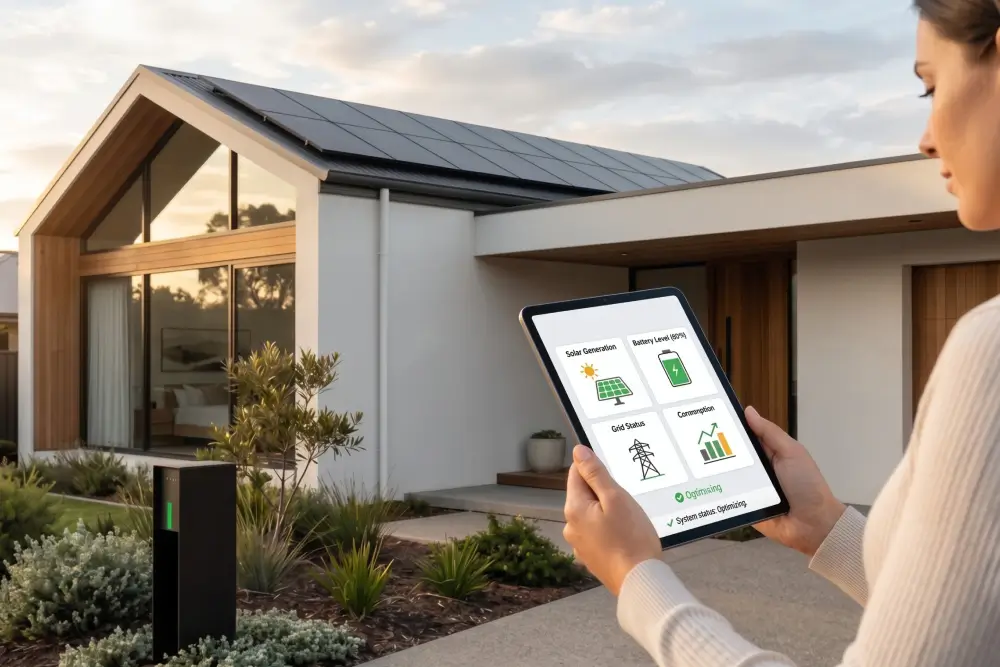
For many Australian households, solar started with one simple goal: use the sun to reduce electricity costs.
Today, the conversation has moved beyond solar panels alone.
With the right combination of solar generation, battery storage, and smart energy management, homeowners can have greater control over when they generate, store, and use electricity.
A battery doesn't simply store energy. It can change how a home uses its own solar power, particularly when solar generation falls in the evening, and household electricity demand continues.
Solar Gives You More Than Energy
Rooftop solar allows your home to generate electricity during daylight hours rather than relying entirely on the grid.
The biggest opportunity comes from using that electricity directly in your home.
Running appliances while solar is being generated can increase solar self-consumption and reduce the amount of electricity you need to purchase from your retailer.
But there is one obvious challenge:
The sun doesn't follow your household schedule.
Solar production is generally strongest during the day, while many households use more electricity in the afternoon and evening.
That's where battery storage can change the equation.
A Battery Moves Energy from Now to Later
Instead of exporting all unused solar generation to the grid, a battery can store some of that excess energy for later use.
For example:
During the day
- Solar generates electricity
- Your home uses what it needs
- Excess energy charges the battery
In the evening
- Solar generation drops
- Battery discharges stored energy
- Your home can use less electricity from the grid
This can increase solar self-consumption and reduce the amount of grid electricity purchased, depending on your usage, system size, electricity plan and battery configuration.
The Real Advantage? More Choice
Energy use doesn't have to be completely passive.
With solar and battery storage, homeowners can have more options around when and how they use electricity.
Depending on the system and electricity plan, a battery may help you:
- Store excess solar energy
- Use more of your own generated electricity
- Reduce grid electricity purchases
- Shift stored energy into higher-cost periods
- Reduce some peak electricity demand
- Potentially participate in a Virtual Power Plant (VPP)
- Provide backup power when the system is designed for it
That doesn't mean every household will achieve the same savings.
Your energy profile matters.
Your Home's Energy Habits Matter More Than You Think
A battery shouldn't be selected simply because it has a larger capacity.
The right system depends on factors such as:
How much electricity do you use?
A household with high evening consumption may have a different battery requirement from a home with relatively low energy use.
When do you use electricity?
If most of your electricity consumption happens after sunset, storing daytime solar could be particularly useful.
How much solar do you generate?
A battery needs surplus energy to be charged. A small solar system may not generate enough excess electricity to make a larger battery worthwhile.
What electricity plan are you on?
Time-of-use pricing, feed-in tariffs, and other tariff structures can influence how a battery operates, and the potential savings it provides.
The Australian Government also recommends considering household electricity use, electricity prices, solar-system size and battery cost when assessing whether a battery makes financial sense.
Don't Buy a Battery Just Because You Can
This is an important part of the conversation.
A battery isn't automatically the right choice for every home.
The Australian Government notes that battery costs can outweigh the financial benefits for some households, depending on their circumstances.
Before choosing a system, look at:
Your electricity bills → your usage patterns → your solar generation → your tariff → your available roof space → your battery requirements.
This gives you a much better starting point than simply choosing the biggest battery available.
What About Blackouts?
Battery storage can also provide another benefit: backup power.
But there's an important distinction.
A standard grid-connected solar system generally shuts down during a grid outage for safety reasons. A battery can provide backup electricity only when the system has been specifically configured for backup operation.
Depending on the system, backup may cover:
- Selected essential circuits
- Lighting and refrigeration
- Certain appliances
- Or a larger portion of the home
The available backup capacity depends on the battery, inverter, system design, and installation.
So, if blackout protection matters to you, make it part of the conversation before installation, not afterwards.
Smart Energy Is About Using Energy Better
The future of residential energy isn't simply about producing more electricity.
It's about using the electricity you already have more intelligently.
Solar can generate energy during the day.
A battery can store surplus energy.
Monitoring can show how your household is using electricity.
Smart controls can help coordinate energy use.
And, where available and suitable, VPP participation can connect household batteries with broader energy-management programs.
Together, these technologies can give homeowners greater visibility and control over their energy.
The Technology Is Only Half the Solution
Choosing the right equipment matters, but so does the installation behind it.
Before committing to a solar and battery system, ask about:
- System sizing
- Battery usable capacity
- Inverter capacity
- Backup functionality
- Product warranties
- Installation requirements
- Monitoring and connectivity
- After-sales support
- Future system expansion
The Australian Government recommends checking battery safety and product standards, warranty conditions, expected lifetime and the credentials of the installer before purchasing.
A professionally designed system should be based on how your home actually uses energy, rather than simply selling you more capacity.
Solar + Battery = More Energy Independence
Solar panels can help your home generate electricity.
Battery storage can help you keep more of that energy for later.
Together, they can give Australian households greater flexibility in how they generate, store and use electricity.
But the goal shouldn't be to install the biggest system possible.
The goal is to build a system that makes sense for your home.
Conclusion
Solar and battery storage are changing the way Australian households think about electricity.
It's no longer simply about producing solar power during the day.
It's about understanding your energy use, storing surplus generation, and having greater control over when you use your electricity.
With the right system design, solar and battery storage can help households increase solar self-consumption, reduce reliance on grid electricity, and potentially improve energy resilience.
Because having more energy isn't necessarily the goal.
Having more control over the energy you already generate is.