



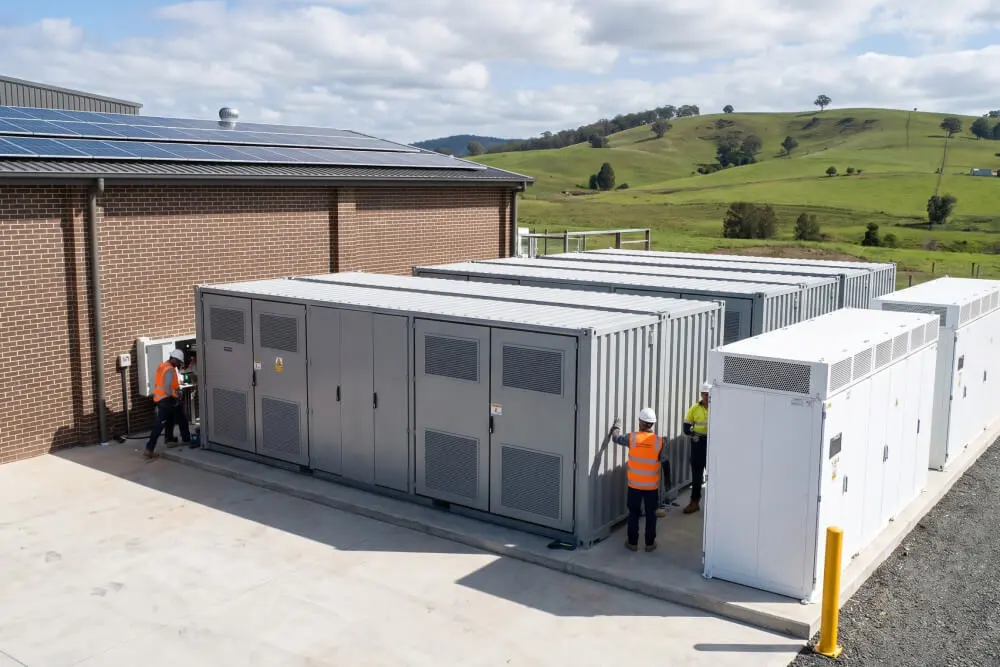
For many Australian businesses, electricity isn't just another operating expense. Running refrigeration, machinery, air conditioning, lighting, and other equipment during high-demand periods can put significant pressure on energy costs.
From 1 September 2026, eligible NSW businesses can access a new battery incentive under the Peak Demand Reduction Scheme (PDRS).
The new BESS4 and BESS5 activities are designed to encourage businesses to install battery energy storage systems that can store electricity and help reduce demand on the NSW electricity grid during peak periods.
BESS4 vs BESS5 - The Simple Breakdown
| Details | BESS4 | BESS5 |
|---|---|---|
| Designed for | Small & medium businesses | Commercial & industrial businesses |
| Battery capacity | >20 kWh to 200 kWh | >200 kWh to 30 MWh |
| Residential sites | Not eligible | Not eligible |
| Data centres | Not eligible | Not eligible |
| Incentive capacity | Within eligible battery capacity | Incentive applies to first 10,000 kWh |
| Start date | 1 September 2026 | 1 September 2026 |
The NSW Government confirms that BESS4 covers batteries with more than 20 kWh and up to 200 kWh of usable capacity. BESS5 covers systems greater than 200 kWh and up to 30 MWh, although the incentive under BESS5 applies only to the first 10,000 kWh.
What Makes This Incentive Different?
This isn't simply a traditional cash rebate.
The PDRS works through Peak Reduction Certificates (PRCs). Eligible activities create certificates representing reductions in peak electricity demand. These certificates can support an upfront discount on eligible battery installations.
For businesses, that can make battery storage more accessible while helping shift energy use away from periods when demand on the electricity network is highest.
In practical terms:
Store energy → use it when demand is high → reduce grid reliance → potentially lower energy costs.
How Much Could a Business Save?
The NSW Government currently describes the incentive as an upfront discount included in the installation quote.
Indicative discounts are:
- Around 20 - 30% when installing a battery alone
- Around 30 - 40% when installing a battery alongside new or additional solar capacity
These are indicative figures, not guaranteed savings. The actual discount depends on factors such as the battery selected, installation location, system design, additional electrical work, and installer costs.
So, businesses should compare quotes rather than assume every installation will receive the same discount.
Battery + Solar Could Mean a Bigger Discount
One of the most interesting parts of the new incentive is the additional benefit available when battery storage is installed with new or additional solar capacity.
To access the higher discount, the new solar must be installed within 90 days before or after the battery installation.
For businesses that already have solar, additional solar capacity can also qualify, provided the new solar capacity is equivalent to at least 25% of the new battery capacity.
Think of it as:
Existing Solar → Add More Solar + Battery → Potentially Higher Incentive
This could be particularly relevant for businesses that have an existing solar system but are now looking to increase onsite energy generation and storage.
Who Can Apply?
The NSW Government states that businesses may be eligible if they:
- Operate in NSW
- Install a battery between 20 kWh and 30 MWh
- Are not a residential building or data center
- Have not previously used this specific discount to install a battery
- Work with an installer offering the incentive
- Obtain required planning approvals
However, battery requirements differ depending on the system size.
For 20–200 kWh systems, the battery must be on the approved battery list, and installation must be completed by an installer on the Solar Accreditation Australia (SAA) installer list.
For systems above 200 kWh, additional technical and safety requirements apply, including required fire-safety testing and installation by a suitably licensed installer.
What About Businesses That Already Have a Battery?
Already having battery storage doesn't automatically rule you out.
The NSW Government says a business with an existing battery may still be eligible to install another battery, provided it has not previously claimed this particular NSW Government discount for a battery installation.
However, a battery that was already commissioned before 1 September 2026 cannot retrospectively receive this new discount.
Why Businesses Are Looking at Battery Storage
The incentive is only one part of the equation.
A properly designed commercial battery can help businesses:
Capture more solar
Store excess solar generation instead of exporting all surplus electricity.
Shift energy use
Use stored electricity when solar generation is low.
Manage energy costs
Reduce reliance on grid electricity during higher-demand periods.
Improve energy resilience
Where the system is configured for backup, battery storage may help keep selected loads operating during outages.
Support cleaner energy use
Using more locally generated renewable energy can reduce reliance on fossil fuel generation.
Before You Install: Don't Choose the Battery First
A commercial battery shouldn't be selected simply because it has a large kWh rating.
Businesses should consider:
Energy consumption → Solar generation → Peak demand → Battery size → Inverter capacity → Operating pattern
Your business may need a different solution depending on whether you operate a retail store, warehouse, medical facility, hospitality venue, manufacturing site or another commercial property.
The right system should be designed around how your business actually uses electricity.
A New Opportunity for NSW Businesses
BESS4 and BESS5 mark an important expansion of NSW's approach to commercial battery storage.
The incentives are aimed at businesses that may not fit traditional household battery programs, while supporting the broader goal of reducing electricity demand during peak periods. The NSW Government estimates that the PDRS will help households and businesses save around $1.2 billion on their electricity bills between 2022 and 2040.
For businesses considering solar, battery storage, or both the new incentive creates another reason to review their energy strategy.
Final Thoughts
The introduction of BESS4 and BESS5 from 1 September 2026 gives eligible NSW businesses a new pathway to reduce the upfront cost of commercial battery installation.
The key is understanding which activity applies, whether your battery and installation meet the requirements, and how solar and battery storage can work together for your business.
Rather than choosing a system based solely on the available incentive, businesses should look at the full energy picture of electricity consumption, solar generation, battery capacity, operating hours, and long-term energy goals.
For an accurate assessment, speak with an installer offering the NSW business battery incentive and compare the final quoted cost, system design and expected benefits before making a decision.