



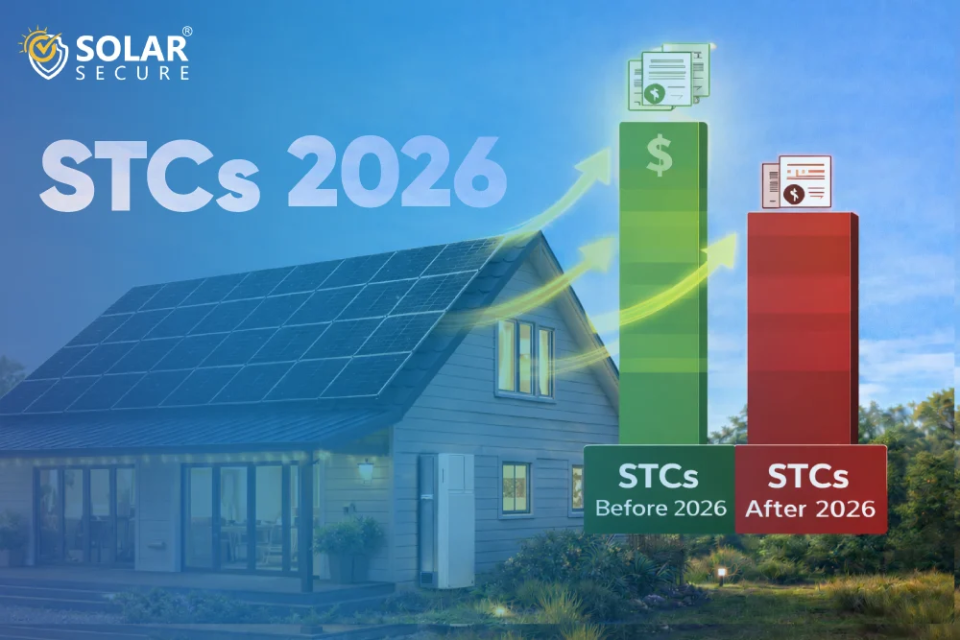
Late December is when many Australian homeowners start second-guessing their solar timing. Quotes are on the table, installers are booking into the new year, and January feels close enough that waiting seems harmless. What often gets missed is that January is not just another month on the calendar. It is when Small-scale Technology Certificates, or STCs, step down again by design.
STCs are one of the main reasons solar systems cost less upfront than their sticker price suggests. They are also quietly shrinking each year as the country’s solar market matures. When January 2026 arrives, the same system on the same roof will attract fewer certificates than it does today. Nothing about the technology changes. The incentive does.
For homeowners, this matters less as a policy detail and more as a timing issue. The reduction does not show up as a line item. It shows up as a higher quote, a slightly longer payback period, or a sense that solar has become more expensive overnight.
Understanding what actually changes in January 2026 helps cut through that confusion and makes it easier to decide whether acting now or waiting makes financial sense for your situation.
Why STCs shrink every year
STCs are built into how Australia’s Small-scale Renewable Energy Scheme was designed and administered by the Clean Energy Regulator. When a solar system is installed, it is awarded STCs based on how much renewable electricity it is expected to generate over a set deeming period. That deeming period shortens every year, gradually stepping down until the scheme ends in 2030. As the deeming period gets shorter, fewer certificates are created for each new installation, even if the system itself is identical.
This gradual reaction is deliberate. The scheme was designed to provide stronger support in the early years of household solar adoption, then taper as technology costs fall and solar becomes more mainstream. In practice, it means incentives fade quietly rather than disappearing all at once.
For homeowners, the key takeaway is simple. January does not bring a new rule or surprise cut. It marks the next scheduled step in a long-planned phase-down, where each new year delivers slightly less support than the one before it.
What actually changes in January 2026
When January 2026 arrives, nothing about solar panels, inverters, or installation standards suddenly changes. The shift happens entirely on the incentive side. The number of STCs a new system is eligible for drops because the deeming period shortens by another year.
In practical terms, this means a new solar installation completed in January 2026 generates fewer certificates than the same system installed in December 2025. That reduction translates directly into a smaller upfront discount. The system has not become worse. The incentive supporting it has simply stepped down again.
This change is easy to miss because STCs are usually applied behind the scenes. Installers typically assign the certificates on the homeowner’s behalf and factor their value straight into the quote. When STCs reduce, quotes quietly rise. There is no announcement, no separate line item, and no clear explanation unless you know to look for it.
This is why January often creates the impression that solar prices have jumped overnight. In reality, it is the same market, the same equipment and the same labour costs. The difference is that the built-in discount from STCs is now smaller than it was just weeks earlier.
How Will These Changes Affect You?
If you plan to install solar panels or battery storage in 2026 or later, expect the upfront financial incentives to be smaller than in previous years. This means:
- Higher initial costs: With fewer STCs, the discount on installation prices will reduce.
- Longer payback periods: The time it takes to recover your investment through energy savings may increase.
- Greater importance of system design: Choosing the right system size and technology becomes more critical to maximize savings.
For example, a 6.6 kW solar system installed in 2025 might receive around 60 STCs, but the same system installed in 2026 could receive closer to 50 STCs. This difference can translate to several hundred dollars less in rebates.
What Can Customers Do to Prepare?
Despite the changes, solar and battery systems remain a smart investment for many households. Here are some practical steps to consider:
- Install sooner rather than later : If you are ready, acting before 2026 can secure higher STC benefits.
- Consult with a trusted installer: Professionals can help design a system that fits your energy needs and budget.
- Consider battery storage carefully: Evaluate how battery incentives will change and whether the investment aligns with your energy goals.
- Explore additional incentives: Some states or local councils offer extra rebates or programs that can supplement STCs.
- Focus on energy efficiency: Combining solar with energy-saving measures can improve overall savings.
Understanding the Bigger Picture
The reduction in STCs is a sign that solar technology is becoming more affordable and widespread. As the market grows, the government is shifting support towards encouraging smarter energy use rather than just installation volume.
This means customers should think beyond just the initial rebate and focus on:
- Long-term energy savings
- Reducing reliance on the grid
- Increasing home energy independence
- Environmental benefits
By planning carefully and staying informed, you can still make the most of solar and battery technology in 2026 and beyond.
Final Thoughts: The Best Time to Go Solar and Battery Is Now
As Australia’s solar market continues to mature, STCs in 2026 will play an increasingly important role in shaping the overall return on investment for solar system owners. While the gradual reduction in STC values is part of the program’s natural phase-down, solar remains a strong and reliable investment when viewed through a long-term lens.
For homeowners and businesses, the key takeaway is timing. Installing solar sooner allows you to access higher STC benefits, reduce upfront costs, and start generating savings immediately. When combined with rising electricity prices, improved solar efficiency, and the growing adoption of battery storage, solar systems in 2026 still offer compelling financial and environmental returns.
As Australia’s one of the most trusted solar providers nationwide, Solar Secure is here to make going solar simple and affordable.
We offer:
- All-inclusive STC rebate processing—no paperwork for you
- Premium Tier 1 solar panels and batteries
- Flexible system sizes from 6.6kW to 30kW+
- State-specific rebates advice for VIC, NSW, SA and more
- Fast installation timelines (subject to availability)
We also help you explore virtual power plant (VPP) options, feed-in tariffs, and battery incentive programs so you can maximise your return.