



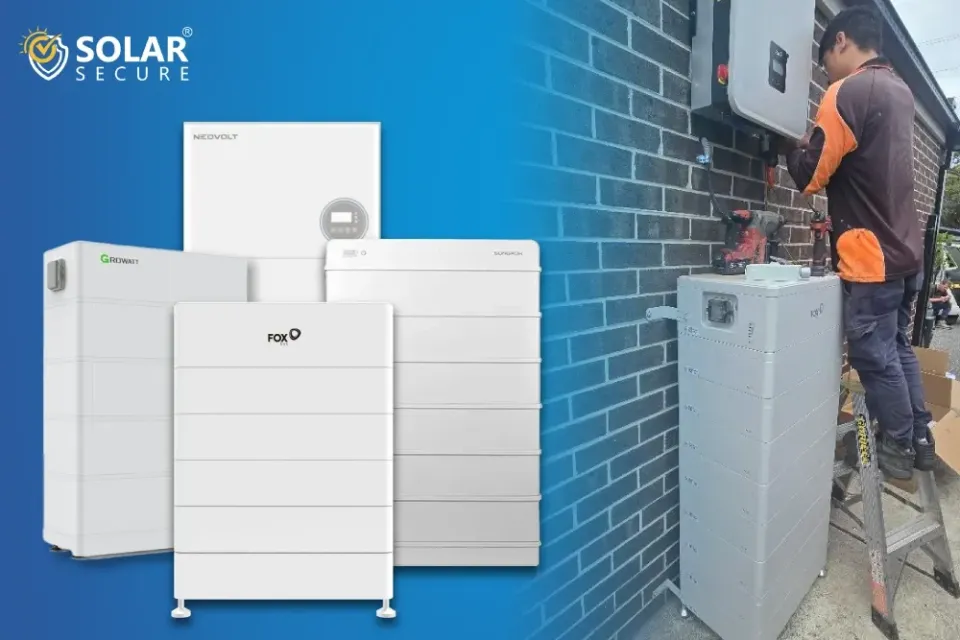
AS5139 is Australia’s official safety standard governing the installation of lithium-ion and other battery energy storage systems, ensuring they are set up to safeguard people, property, and the electricity grid.
- Low-voltage battery systems (up to 1,500 V DC or 1,000 V AC)
- Residential, commercial, and industrial buildings
- New battery installations and retrofits
This standard applies to:
Adding battery storage to home solar systems is an increasingly popular choice with a plethora of options for both full off-grid systems, as well as grid-connected systems popping up for consumers.
An important factor in considering adding batteries, especially if you’re going to install them yourself, is to ensure that their installation complies with the Australian Standards (AS5139) which were recently updated in October 2019.
AS5139 governs the installation of all newly installed or altered battery systems rated at ≥12V and ≥1kWh, including systems equivalent to a 12V, 90Ah battery, in residential and commercial premises. Exclusions include mobile applications such as caravans, as well as UPS and telecommunications systems.
Categories
The standard sets up three different categories for batteries.
Category 1 - Category 1 covers Clean Energy Council (CEC) approved pre-assembled integrated battery energy storage systems, which essentially is a CEC approved lithium battery systems with internal fuses and an inverter such as the Tesla Powerwall 2. These have the fewest rules and are the easiest to install, but with the drawback of offering the least amount of customisation. The rules here relate mostly to location, testing, and documentation.
Category 2 - Category 2 covers CEC approved pre-assembled battery systems, which is a CEC approved lithium battery with internal fuses but without an inverter which must be installed separately. The added complexity means that it has a few more pages of rules for installation. These have all the same rules as Category 1 but also require specific requirements for wiring, fusing, earthing, and that kind of thing.
Category 3 - Category 3 covers all non-CEC approved batteries which includes lithium batteries that haven’t been approved by the CEC, as well as lead-acid batteries and any other strange battery you’ve had your eye on. Category 3 batteries must meet all the requirements as 2 and 1, but also must meet rules on ventilation, enclosure design, voltage drop, and arcing.
New Systems
The rules for installing a new battery system have some pretty important limits on location, with the general vibe being an external house wall or inside a garage being ideal locations.
The standards prohibit batteries being installed in a “habitable room” (basically anything inside), or anywhere like (wall cavities, ceiling spaces etc) or anywhere that might be a dangerous if something goes wrong (e.g. evacuation route, or near flammable material).
Batteries can also not be installed close to windows or doors, or other electronic appliances such as hot water units or air conditioners. If the battery is installed on the other side of a habitable room, then it needs to have appropriate shielding between it and the room. Finally, category 3 batteries have a few more limits, and in particular category 3 lithium batteries or high voltage battery systems must be installed in a structure detached from the house.
Existing System
The good news if you’ve got a system that pre-dates the new rules coming in is that they don’t apply retrospectively so you aren’t legally required to do anything to your system. The rules are very much there for your safety, so if there’s a glaring anomaly between your system and the updated rules, it is certainly worth considering modifying things to be more complaint.
But the key thing to note is that any upgrade or modification to an existing system triggers a requirement that the whole system meet the new standards. And in addition there are some complex rules regarding the safety equipment required to be worn for inspection and maintenance of systems, especially older lead-acid ones, but the specific rules can only be accessed by purchasing a copy of the Standards, so it is very difficult for a normal home user to know exactly what rules they are required to follow, especially when following the rules is often a requirement for the warranty.
AS5139 – Regulatory Framework for Battery Installation
1. Installation Location Requirements
AS5139 has strict rules on where batteries can and cannot be installed to reduce risk in case of fire, gas leakage, or explosion.
- Habitable rooms (e.g., bedrooms, living rooms, kitchens)
- Roof spaces or ceiling voids
- Wall cavities
- Under staircases
- Exits and escape routes
Prohibited Locations:
- Garages, storage rooms, or service rooms
- Exterior walls (with proper protection and spacing)
- Dedicated weatherproof outdoor battery enclosures
- Fire-rated internal enclosures
Approved Locations:
Batteries must have clear space around them, typically 600 mm from combustible materials unless the enclosure is certified otherwise.
2. Battery Enclosure (BESS Zone) Rules
- Must be physically protected (from impact, fire, etc.)
- Must allow natural or mechanical ventilation
- Should be made from or surrounded by non-combustible materials
- May require a fire rating, especially for indoor installs
A BESS Zone is a controlled area around the battery system.
Requirements:
3. Safety and Fire Risk Management
- Lithium-ion batteries carry a risk of thermal runaway, which can lead to fire.
Fire and Thermal Runaway
- Installation in fire-safe areas
- Proper system spacing and separation from flammable materials
- System shutdown mechanisms in case of faults
AS5139 requires:
Emergency Provisions
- Isolators or emergency shutdown switches
- Signage for first responders
- Clear labelling of battery chemistry, voltage, and capacity
Installations must include:
4. Signage and Labelling
Installers must place permanent, visible labels near the battery system.
- Battery type (e.g. lithium iron phosphate)
- Nominal voltage and capacity
- Manufacturer details
- Warnings (e.g. Risk of Fire)
- Emergency shutdown procedures
Labels should include:
5. Installer Responsibilities
Only qualified and licensed electricians can install BESS under AS5139. Requirements include:
- Specific training in battery storage systems
- Site risk assessment before installation
- Installation documentation and handover to customer
- Compliance with local electrical rules (e.g. AS3000)
6. Product Compliance
Batteries and inverters used in installations must:
- Be tested and certified to meet relevant standards
- Appear on the Clean Energy Council (CEC) approved list
- Include a Battery Management System (BMS) for safety
Tip: Batteries not certified to AS5139 may make you ineligible for government rebates.
7. Inspection and Compliance Documentation
- Installers must issue a Certificate of Electrical Safety (COES) or state-specific equivalent.
- Some jurisdictions require a grid connection application and inspection.
Upon completion:
8. Relevance to Homeowners
- Ensures your system is safe and legal
- Helps qualify for rebates and warranties
- Protects your home insurance coverage
Why it matters:
Summary Table
AS5139 Battery Installation Requirements
| Feature | AS5139 Requirement |
|---|---|
| Allowed Battery Locations | Non-habitable rooms, external walls, certified enclosures |
| Prohibited Battery Locations | Bedrooms, kitchens, wall cavities, roof spaces |
| Fire & Safety Clearances | Typically 600 mm clearance around the battery |
| Mandatory Signage | Battery type, capacity, emergency instructions |
| Installer Qualification | Licensed electrician with battery training |
| Battery Certification | Product must comply with AS5139 standards & CEC approved |
| Enclosure Requirements | Fire-safe, ventilated, secure |
| Emergency Access | Isolators and clear labelling for first responders |
Conclusion
The rollout of AS5139 represents a major advancement in improving the safety of home battery installations throughout Australia. The standard is designed to minimise fire risks, enhance system performance, and protect both homeowners and installers. By understanding and complying with AS5139, homeowners can feel confident their battery system meets current safety requirements. As solar and storage adoption continues to rise, following AS5139 is not only mandatory, but also a proactive step toward safer, more reliable, and future-proof energy solutions.